
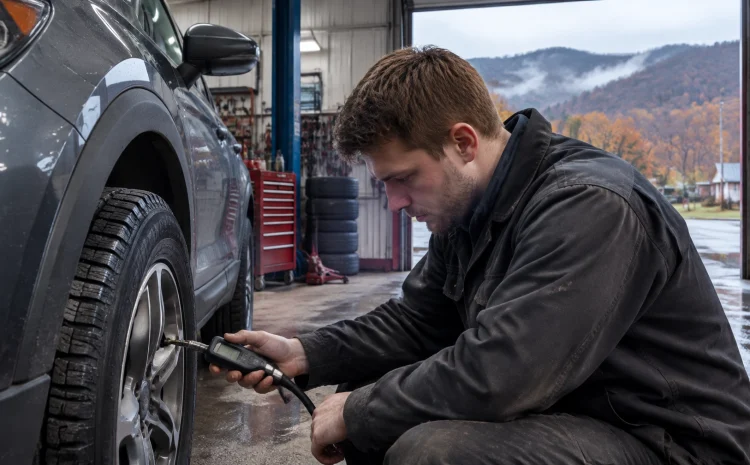
Cold Weather Tire Pressure: Why Your TPMS Light Comes On Every October
If your tire pressure monitoring system, or TPMS, seems to turn on every October, your vehicle probably is not being dramatic. The first cold mornings of fall can lower tire pressure enough to trigger the warning light, especially if your tires were already close to the vehicle manufacturer’s minimum setting.
For drivers in White Hall, Fairmont, and the surrounding West Virginia hills, this is a good time to check more than just the weather forecast. Falling temperatures, changing road conditions, potholes, and longer winter commutes all put extra importance on properly inflated tires.
The good news is that a TPMS light is often easy to address. The important part is knowing whether you are seeing a normal seasonal pressure change or a warning sign of a real tire problem.
Why Tire Pressure Drops When Temperatures Fall
The air inside your tire responds to temperature. As the air gets colder, it takes up slightly less space and exerts less pressure against the inside of the tire.
A common rule of thumb is that tire pressure changes by about 1 PSI for every 10°F change in temperature. So, if your tires were set during a warm September afternoon and the temperature drops 30°F by late October, each tire could lose roughly 3 PSI.
That may be enough to turn off your TPMS light in September and switch it on during a cold November morning.
This pressure change does not necessarily mean the tire has a puncture. All four tires may lose pressure at approximately the same rate simply because the weather changed. Still, you should not ignore the warning. A tire that is already underinflated can affect handling, braking, fuel economy, and tread life.
When the tires warm up from driving, the air inside them expands slightly. That can cause the TPMS light to go off later in the day. However, the tire has not magically returned to the correct pressure. It is still important to check and adjust it while cold.
What the TPMS Light Is Telling You
Your TPMS monitors tire pressure and warns you when one or more tires fall below the vehicle’s programmed threshold. It is a helpful early warning system, but it does not fill the tires for you or replace a manual pressure check.
If the light comes on steadily, check all four tires as soon as it is safe and practical to do so. Do not assume the tire that looks low is the only one that needs attention.
If the TPMS light flashes when you start the vehicle and then stays on, that may indicate a problem with the monitoring system itself rather than low pressure alone. The exact warning pattern varies by vehicle, so check your owner’s manual or have the system inspected.
A warning that disappears after driving still deserves attention. Seasonal pressure loss can be gradual, and driving on underinflated tires for weeks can cause unnecessary wear or internal damage.
How to Check and Set Tire Pressure Correctly
The most reliable time to check tire pressure is when the tires are cold. Ideally, the vehicle should have been parked for at least three hours. If you need to drive to an air pump, try to travel less than a mile at moderate speed before measuring.
Follow these steps:
- Find the recommended pressure on the sticker inside the driver’s door jamb. It may also be listed in your owner’s manual.
- Remove the valve cap and press an accurate tire gauge firmly onto the valve stem.
- Check every tire, including the spare if your vehicle has one.
- Add air until each tire reaches the recommended cold pressure.
- Replace the valve caps securely.
- Drive briefly if your owner’s manual says the TPMS needs movement to reset, then confirm whether the warning clears.
Use the pressure listed on the door-jamb sticker, not the maximum PSI molded into the tire sidewall. The sidewall number describes the tire’s maximum allowable pressure under specific conditions. It is not necessarily the correct setting for your car, truck, or SUV.
Do not release air from a warm tire just because the gauge shows a higher number. Warm tires naturally read higher after driving. Wait until they cool, then check them again.
Why Eyeballing Tires Does Not Work
A tire can be several PSI low and still look normal from the outside. Modern radial tires are designed with sturdy sidewalls, so visual inspection is not a dependable way to judge inflation.
Cheap or damaged gauges can also give inconsistent readings. You do not necessarily need the most expensive gauge available, but it should be in good condition and used consistently. If your gauge gives a very different reading from the gauge at a trusted tire shop or air station, compare it with another reliable gauge.
The goal is not to guess whether a tire “looks okay.” The goal is to measure it accurately against the pressure specified for your vehicle.
A few extra minutes with a dependable gauge can help prevent uneven tread wear, reduced fuel economy, and poor handling on wet or icy roads.
Cold Weather Affects More Than Pressure
Temperature changes also influence how your tires grip the road. As the weather gets colder, many standard all-season tire compounds become less flexible. That does not automatically mean you need winter tires, but it does mean tread condition and correct inflation matter more as temperatures fall.
Proper inflation helps the tread maintain the contact patch. The portion of rubber touching the road. If a tire is underinflated, its tread may not work as designed. Steering can feel less precise, braking performance can suffer, and the tire may flex more than it should.
Underinflation can also create extra heat inside the tire during highway driving. Over time, that may contribute to premature wear or tire damage.
On West Virginia’s hills, a vehicle with four-wheel drive or all-wheel drive can feel confident when accelerating, but those systems do not eliminate the need for proper tires. They do not shorten braking distances on ice, and they cannot compensate for worn tread or low pressure.

Cold Weather Pressure or a Real Leak?
The pattern of pressure loss can offer a useful clue.
If all four tires are down by a similar amount after a sharp temperature drop, the weather is a likely factor. You should still inflate them to the correct cold pressure and continue monitoring them.
A single tire that keeps losing air deserves closer attention. So does a tire that loses pressure much faster than the others. Possible causes include:
- A nail, screw, or other puncture
- A leaking valve stem
- Damage where the tire seals against the wheel
- A bent or cracked wheel
- Sidewall or tread damage
- Previous tire damage that was not repaired correctly
Do not repeatedly add air to the same tire and assume the problem is solved. A slow leak can become a serious problem when temperatures drop again or when you are traveling at highway speed.
If the tire is visibly low, has a bulge, shows sidewall cracking, or cannot hold pressure, avoid driving farther than necessary. A professional inspection at a tire repair shop near me can determine whether the tire can be safely repaired or needs replacement.
When to Visit a Tire Shop
A professional inspection is a smart choice when:
- The TPMS light returns soon after you set the pressure
- One tire loses air repeatedly
- You see a nail, screw, bulge, cut, or sidewall crack
- Your vehicle pulls to one side
- The steering wheel vibrates
- The tread is wearing unevenly
- The TPMS light flashes instead of staying steadily illuminated
- You are preparing for a long trip through changing mountain weather
A technician can check pressure, tread depth, valve stems, wheel condition, and signs of puncture or uneven wear. If the tires are wearing on one edge, a wheel alignment may also be needed. Catching that issue early can extend the life of a newer set of tires and help prevent a more expensive replacement.
This is also a practical time to schedule a seasonal check before your state inspection. If you are searching for a car inspection near me around White Hall, tire condition is one of the areas worth addressing before your appointment. Proper pressure will not fix a tire with unsafe tread or damage, but it can help you identify problems before they become urgent.
A Simple October Tire Routine
When the first cold mornings arrive, make tire pressure part of your seasonal routine:
- Check the pressure on a cold morning.
- Set each tire to the door-jamb recommendation.
- Look for punctures, cracks, bulges, and uneven tread wear.
- Recheck the tires monthly and before long trips.
- Check again after a major temperature change.
- Have a professional inspect any tire that repeatedly loses air.
Winston Wheels & Tires provides tire pressure checks, tire repairs, tire replacements, wheel services, alignments, and general auto care in White Hall. Our team can help you understand what your vehicle needs without guessing or recommending work it does not need.
Keep Your Tires Ready for the Road Ahead
A TPMS light in October is often a reminder that the seasons have changed, not proof that your vehicle has a major problem. Check the pressure cold, use the door-jamb specification, and pay attention to repeated pressure loss or visible damage.
If the warning keeps returning, stop searching for a quick air top-off and let a professional inspect the tire. Contact Winston Wheels & Tires or book a service appointment in White Hall, WV, so you can head into the colder months with dependable traction and confidence.